What Is the Most Remote Place on Earth?
Ask ten people what the most remote place on Earth is and you’ll probably get the same answer: some tiny island in the middle of the Pacific.
Fair guess. Wrong answer.
Or at least not the whole answer.
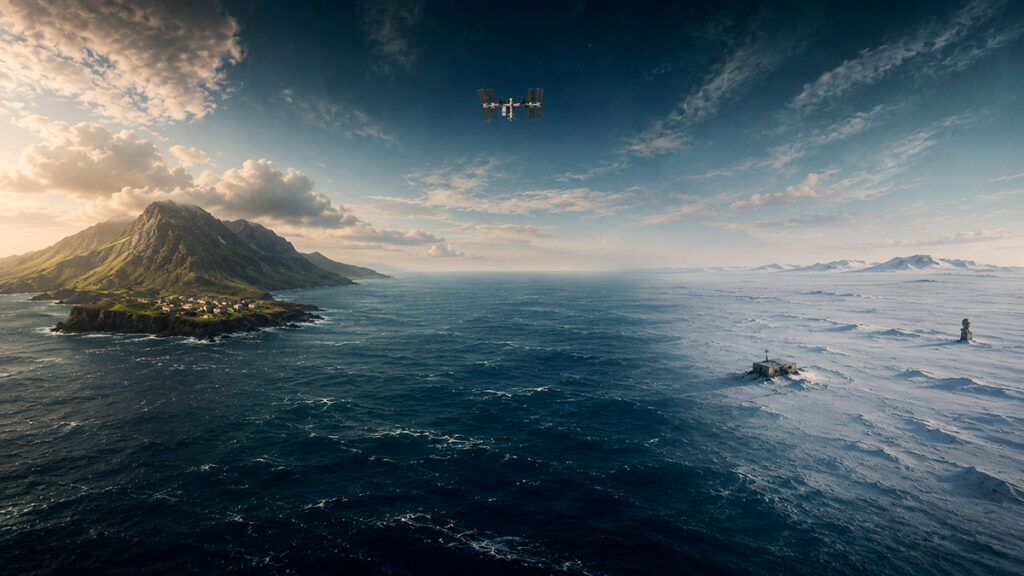
The problem is that “remote” turns out to be a surprisingly slippery word. Are we talking about the place farthest from any land? The most isolated place where people actually live? Or the hardest location on Earth to reach?
As it turns out, Earth has several strong candidates. And each one manages to make the others look surprisingly accessible.
The Place Where Even the Ocean Feels Empty
If you ask most geographers, the winner is Point Nemo. The name comes from Captain Nemo, Jules Verne’s mysterious submarine captain. Fittingly, “nemo” is Latin for “nobody.” And nobody is exactly who you’ll find there.
Point Nemo is the oceanic pole of inaccessibility — the point in the world’s oceans that is farther from land than any other location on Earth. The nearest bits of land are tiny islands and Antarctic outcrops, all roughly 2,688 kilometers (1,670 miles) away.
To put that into perspective:
- London to Rome: about 1,400 km
- New York to Miami: about 1,750 km
- Point Nemo to the nearest land: 2,688 km
You could sail for days and still be nowhere near anything.
The region is so isolated that it contains very little marine life. Ocean currents prevent nutrient-rich water from reaching the area, making it one of the least biologically active regions of the world’s oceans.
And here’s the detail that sounds completely invented but happens to be true:
Sometimes the closest humans to Point Nemo are astronauts aboard the International Space Station. When the ISS passes overhead, the astronauts are only about 400 kilometers away—far closer than any person on land.
That’s the sort of fact that sounds like a screenwriter got carried away and nobody in the room bothered to fact-check it.
There are very few places on Earth where you can honestly say your nearest neighbors might be in space.
The Most Remote Place People Actually Call Home
Of course, Point Nemo isn’t a place you can live. For that title, we need to head to the South Atlantic Ocean. There, roughly halfway between South America and Africa, sits Tristan da Cunha.
It is widely regarded as the most remote inhabited island in the world. The nearest continent is Africa, more than 2,700 kilometers away, and there is no airport. If you want to visit, you’re taking a boat.
The island’s main settlement has one of the greatest place names ever invented: Edinburgh of the Seven Seas. Population? Around 250 people.
There are no traffic jams, no rush hour, no spontaneous weekend shopping trip.
Supply ships arrive only occasionally, and residents often have to plan purchases months in advance. Yet many islanders love living there. The community is close-knit. Crime is almost nonexistent. Children can wander freely. Everyone knows everyone else.
Whether that sounds idyllic or horrifying probably says a lot about you.
Imagine accidentally sending an embarrassing message to the wrong group chat and realizing that, on Tristan da Cunha, the entire island would probably know about it before dinner.
The Place That’s Hardest to Reach
Now let’s make things more difficult. Suppose remoteness isn’t about distance from civilization. Suppose it’s about difficulty. That brings us to Antarctica’s Pole of Inaccessibility.
Unlike the South Pole, which is already spectacularly inconvenient, the Pole of Inaccessibility is the point on the Antarctic continent farthest from the surrounding ocean. Depending on how researchers define the coastline, it lies more than 1,300 kilometers from the South Pole itself.
The Soviet Union once built a tiny research station there. Then they left.
Today, one of the most famous sights at the site is a weather-beaten bust of Joseph Stalin staring out across one of the harshest environments on Earth.
Temperatures can plunge below -50°C (-58°F). The winds are brutal. The landscape is almost featureless. And if you’re wondering what else there is to see, the answer is mostly more Antarctica.
If Point Nemo feels lonely, the Pole of Inaccessibility feels like the planet’s way of saying, “You’ve gone far enough.”
Why We’re Fascinated by Remote Places
Most of us spend our lives trying to avoid remoteness: Better roads, faster internet, shorter commutes, food delivered to the front door.
The entire modern world is basically one giant project aimed at making everything feel closer. Yet we’re strangely fascinated by places at the opposite extreme. Maybe it’s because remote places remind us how large the world still is.
Modern technology creates the comforting illusion that Earth has become small. We are able to video-call someone on another continent and we can see satellite images of almost anywhere. We can order products made thousands of kilometers away without thinking twice about it.
And then you discover that there’s a patch of ocean where astronauts are sometimes the nearest people. Suddenly the planet feels much bigger.
There’s also something appealing about places that exist largely without us. They remind us that despite our cities, highways, smartphones and satellites, vast parts of Earth continue their business without the slightest interest in humanity’s plans.
Nature remains perfectly capable of ignoring us.
Fun Fact
Small fact. Big conversation starter.
The World’s Most Expensive Space Junk Graveyard
Point Nemo isn’t just remote. Because it’s so far from shipping routes and populated areas, space agencies often use the surrounding ocean as a controlled “spacecraft cemetery.”
More than 250 retired spacecraft, satellites and space stations have been deliberately guided to crash into the waters near Point Nemo over the years.
Somewhere beneath those waves lies one of the strangest junkyards on Earth: a graveyard made entirely of objects that once orbited the planet.
So… What Is the Most Remote Place on Earth?
The frustrating answer is: It depends. If you mean the point farthest from land, it’s Point Nemo. If it’s about the most isolated community, it’s Tristan da Cunha. And if yoiu’re referring to the hardest place to reach on land, Antarctica’s Pole of Inaccessibility has a strong claim.
But maybe the more interesting conclusion is that Earth is large enough to have several different definitions of “middle of nowhere.” And all of them are surprisingly convincing. Maybe that’s what makes Point Nemo so fascinating. Not what’s there, but what isn’t: No cities, no shipping lanes, no airports, no holiday resorts selling fridge magnets.
Just a patch of ocean so empty that astronauts occasionally qualify as the local neighbourhood. In a surprisingly crowded world, that’s still a remarkable thing.
Sources
Pole of Inaccessibility (including Point Nemo)
https://en.wikipedia.org/wiki/Pole_of_inaccessibility
Tristan da Cunha – Official Information
https://ukota.org/member-territories/tristan-da-cunha/
National Geographic – Tristan da Cunha
https://www.nationalgeographic.org/society/our-programs/pristine-seas/tristan-da-cunha/
Spacecraft Cemetery
https://en.wikipedia.org/wiki/Spacecraft_cemetery
Explore more Curious Stuff
Enjoyed this strange little corner of the internet?
Discover more bizarre facts, unexpected stories and wonderfully useless knowledge in our Curious Stuff collection.
→ Browse Curious Stuff